Messy Closet, Premium Price Tag: How Fashion Turned 'Keeping It Real' Into a Business Model
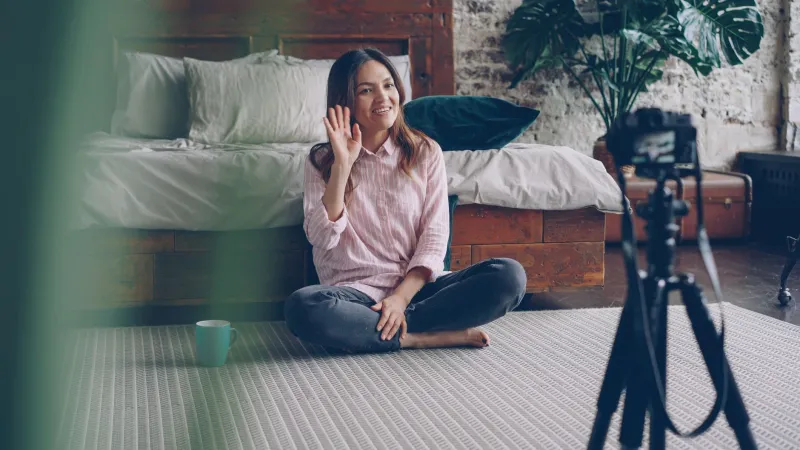
There's a creator you've probably seen on your For You page. She films in bad lighting. Her room is a controlled disaster. She holds up a wrinkled thrifted blazer and says, 'I don't know, I just liked it.' No ring light. No carefully arranged flat lay. No affiliate link disguised as a personal recommendation.
And she has 2.3 million followers.
Here's the thing nobody wants to say out loud: that 'I don't know, I just liked it' moment? It's a craft. The bad lighting is intentional. The messy room is a set. And the brands sliding into her DMs are paying a premium to be part of it.
Welcome to the authenticity economy — where being real is the hottest product in fashion, and the price of entry keeps climbing.
The Anti-Influencer Influencer
Let's rewind. The mid-2010s gave us the Age of Perfection: symmetrical shelfies, editorial-grade selfies, and influencers who seemed to exist in a permanently golden-hour universe. Every outfit was a campaign. Every caption was a billboard. And audiences, especially younger ones, started clocking the performance.
By the early 2020s, Gen Z was openly rejecting that world. 'De-influencing' went viral. The 'that girl' aesthetic got dragged. People started craving something that felt less like a catalog and more like a conversation. Rough edits, candid opinions, and yes — messy closets — became the new visual language of trust.
Brands, ever-adaptive organisms that they are, noticed immediately.
Instead of sending PR packages to polished mega-influencers, marketing budgets shifted toward creators who looked like they might actually return the item if it didn't fit. Partnerships started requiring creators to film in their actual apartments, not rented studios. The 'authentic reaction' became a deliverable.
The irony practically writes itself.
What 'Raw' Actually Costs
Spend ten minutes on any creator's TikTok and you'll start to see the seams. The 'no-makeup' look that requires four skincare products and a specific ring light setting. The 'random thrift find' that was actually sourced by a stylist. The 'honest review' that's technically sponsored but disclosed in 0.3-second gray text at the bottom of the screen.
This isn't a callout — it's just the reality of how content creation works at scale. The problem isn't that creators are performing authenticity. It's that the performance has gotten so sophisticated that audiences have started paying a premium for the illusion of access without realizing it.
Brands like Aritzia, Reformation, and a wave of DTC labels have leaned hard into 'real customer' aesthetics in their campaigns — grainy user-generated content, real bodies in unstaged settings, copy that sounds like a text from a friend. And it works. Conversion rates on UGC-style content routinely outperform traditional editorial photography. Consumers respond to imperfection because it signals honesty.
But here's the catch: those 'real customer' campaigns are produced. The UGC is curated. The imperfection is art-directed.
Vulnerability as a Vertical
Some creators have gone even further, building entire personal brands around emotional transparency. Talking about body image on the way to a try-on haul. Opening up about financial anxiety before showing a thrift flip. Using mental health check-ins as a bridge to outfit reveals.
This content often performs extraordinarily well, and that's not an accident. Vulnerability creates parasocial intimacy — the feeling that you actually know someone — and parasocial intimacy drives purchase behavior more reliably than any discount code.
Nobody's saying these creators are lying about their struggles. But there's a meaningful difference between sharing something personal and packaging personal struggle as a funnel. When the 'I've been having a hard time lately' moment is immediately followed by 'which is why I've been living in these sweats from [brand],' the emotional beat becomes a marketing beat.
And audiences — particularly Gen Z, who grew up fluent in media literacy — are starting to feel that dissonance.
The Class Dimension Nobody's Talking About
Here's where it gets thornier. The aesthetics of 'authentic' dressing — thrifted layers, beat-up sneakers, no-label basics — have become a flex of a very particular kind. It's a look that says I don't need to try, which, paradoxically, requires a lot of trying.
Pulling off studied nonchalance takes style knowledge, time, and often money. The 'random' vintage Levi's jacket? Sourced from a curated Depop seller at a markup. The 'beat-up' sneakers? A limited collab that retailed at $180. The 'effortless' tote bag? Toteme. Quiet, expensive, deliberate.
When authenticity becomes aspirational, it reproduces the same exclusions as every other fashion moment before it — just with better PR. Working-class people who have to shop at Goodwill don't get credited for the aesthetic. The credit goes to the influencer who chose it.
This isn't a new critique — fashion has always laundered class anxiety through aesthetics. But the authenticity era makes it harder to name because the whole point is that nobody's supposed to look like they're trying.
Can You Actually Buy Your Way to Real?
Some brands are genuinely trying to thread this needle. Smaller labels have built real community feedback loops into their design process, not as a marketing tactic but as an operational one. Independent designers on Instagram post work-in-progress photos not because it's content strategy but because that's just how they work. There are creators out there whose mess is actually their mess, whose opinions are actually their opinions, and whose closets are genuinely chaotic.
The challenge is that the market can't tell the difference anymore — and increasingly, neither can we.
Authenticity as an aesthetic has become so codified that it functions exactly like every other trend: it can be replicated, mass-produced, and sold back to you. The 'raw' filter is just a filter. The 'no-edit' edit still involves choosing what to show. Every act of curation, however casual it looks, is still curation.
Maybe that's fine. Maybe performance and sincerity have always been closer together than we want to admit, in fashion and everywhere else.
So Where Does That Leave Us?
If you're a style-conscious person trying to figure out who to trust and what to buy, the authenticity economy doesn't make things easier — it makes them harder. The signals we used to use to identify genuine taste (imperfection, casualness, visible effort) have all been absorbed into the marketing machine.
What's left? Probably the oldest tool in the kit: your own eye. Not the algorithm's version of your eye, or the brand's version, or the creator's version — yours. The fit that makes you feel something without you being able to explain why. The piece you keep reaching for even when it doesn't photograph well.
That's the one thing that actually can't be monetized.
At least, not yet.