Someone Will Charge You $300 to Tell You That Blazer Still Fits
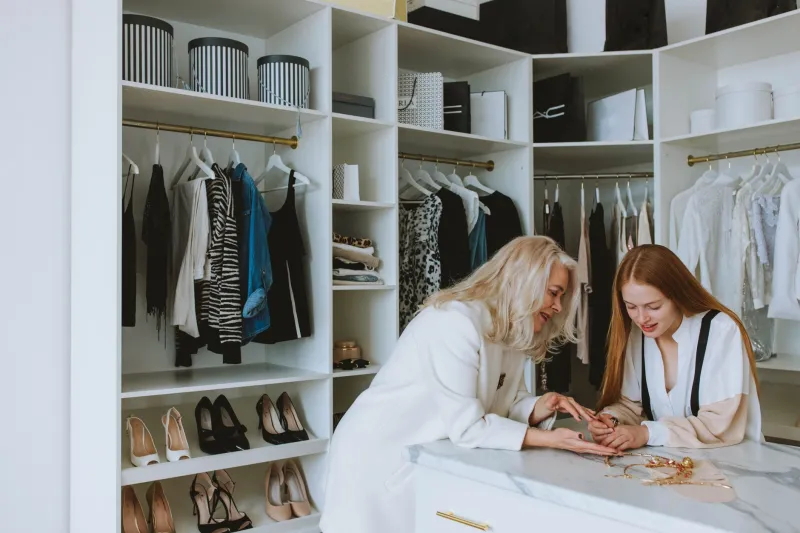
Let's set the scene. You're standing in front of a closet packed so tight the rod is starting to bow. You have clothes with the tags still on, a stack of jeans in three different sizes, and approximately seven black T-shirts you've convinced yourself are all slightly different. You know what you own. You're just not sure what to do with it.
Enter the closet consultant — part therapist, part personal shopper, part hype person — ready to spend three hours telling you what you already know for somewhere between $150 and $800 a session.
This is the wardrobing industry, and business is absolutely booming.
The Audit Economy Has Entered the Chat
Personal styling has always existed at the high end of the fashion food chain. Celebrities have had full-time stylists forever. But what's changed in the last few years is who's buying in. The closet audit — a structured, often expensive session where a professional physically goes through your wardrobe and tells you what to keep, donate, restyle, or buy — has become a genuine middle-class splurge. Think of it as the SoulCycle of getting dressed.
Platforms like StyleBook, Cladwell, and a wave of independent stylists flooding Instagram and TikTok have made the service feel approachable, even aspirational. You're not hiring help because you're lost — you're hiring help because you're investing in yourself. That reframe is doing a lot of heavy lifting.
According to market research from IBISWorld, the personal styling and image consulting industry in the US pulls in over $1 billion annually, with consistent year-over-year growth. Post-pandemic wardrobe confusion — what do I even wear to the office anymore? — accelerated demand in a way nobody really predicted.
What Actually Happens in a Closet Audit
Depending on who you hire, a wardrobing session can look wildly different. Some consultants are strictly edit-focused: they help you purge, organize, and identify gaps. Others go full lifestyle deep-dive — asking about your job, your social calendar, how you feel in certain clothes — before touching a single hanger.
Chicago-based stylist Renata Osei, who's been doing closet consultations for six years, describes her process as "wardrobe archaeology." "Most of my clients already have great pieces," she told us. "They just don't trust themselves enough to wear them. My job is basically to give them permission."
That word — permission — comes up a lot in this space. And it raises a genuinely interesting question: why do so many people need an outside authority to validate their own taste?
Is This Minimalism or Is This a Flex?
Here's where it gets a little complicated. The closet audit has positioned itself as an antidote to overconsumption — a way to shop your own wardrobe instead of buying new. And on the surface, that's a solid premise. Fast fashion has left a lot of people with overstuffed closets and zero coherent aesthetic. Having someone help you make sense of the chaos? That tracks.
But let's be real about who's actually paying for this service. At $300 to $800 a pop, closet consulting isn't accessible to most people. What gets sold as mindful minimalism is, in practice, a premium service for people with disposable income and too many options. The irony of spending several hundred dollars to be told to own less is not lost on everyone.
"It's a wealth flex wrapped in wellness language," says Marcus Delray, a cultural critic and fashion commentator based in Atlanta. "Minimalism has always had a class problem. Now it has a service industry attached to it."
That critique has some teeth. The aesthetic of the perfectly curated, expertly edited wardrobe — the 'capsule collection' ideal — is deeply rooted in the idea that more is less, but only if you can afford the right less. A $400 consultation that ends with a recommendation to buy a $600 coat isn't exactly a frugality exercise.
The TikTok Effect on Personal Style Confidence
It's worth asking why this industry is growing right now, specifically. And the honest answer is that social media has done a number on people's ability to trust their own instincts.
When your feed is a constant parade of perfectly styled outfits, trend breakdowns, and influencers confidently declaring what's in and what's done, it's genuinely hard to feel like your own eye is good enough. The algorithm doesn't just show you fashion — it grades you. That low-key anxiety about whether your style is "right" has created a market for people who will just tell you it is.
Stylist and content creator Jade Morrow, who runs a wardrobing service out of Brooklyn and has built a following on her no-nonsense TikTok content, sees this dynamic clearly. "People come to me because they've been watching too much content," she says bluntly. "They have great style. They just don't believe it anymore because they've been told to doubt it."
Morrow charges on a sliding scale and offers virtual sessions starting at $75 — a model she built specifically to make the service less gatekept. "If this industry only serves people who can already afford to look good, what's the point?"
So Do You Actually Need One?
Honest answer: maybe, but probably not in the way it's being marketed.
There's real value in having someone help you see your wardrobe with fresh eyes, especially if you've been stuck in a style rut or genuinely don't know where to start. A good stylist can help you identify what you're avoiding and why. That's legitimately useful.
But the closet audit as a recurring luxury service — as a lifestyle subscription, essentially — says more about how successfully the fashion industry has convinced us that personal style is too complicated to figure out alone than it does about any actual need.
You probably already know what looks good on you. You've just been told, by a thousand different platforms and trend cycles and influencer opinions, to second-guess it.
The blazer still fits. You knew that. You just needed someone to charge you $300 to agree.